


FORTRESSES on Lake Scutari

IMMERSED AND HIDDEN IN THE SURROUNDINGS AND IN THE WATERS OF THE LAKE, THESE REMAINS OF THE PAST STILL EXPRESS AN INCREDIBLE CHARM.
Despite the lake's tranquility and largely unspoiled nature, this part of Montenegro has often witnessed a turbulent history. It was inhabited by Illyrians, Greeks, and Romans, was part of the Byzantine Empire, and was invaded and occupied by the Ottoman Empire for five centuries, as evidenced by the many ruins on the mainland and some of the lake's islands. There are 18 archaeological remains, including monasteries, monuments, churches, and fortresses;In this post, I’ll focus on the fortresses.
Fortresses on Like Scutari.
Grmozur

Grmozur was built in the 19th century as a Turkish fortress and a few years later it was conquered by the Montenegrins who turned it into a prison.
Escaping from the prison was impossible. Most of the convicts could not swim, and the guards did not have boats, which certainly prevented any escape attempt by the prisoners. If a prisoner escaped, the responsible guard would have to take his place and serve his sentence, making any assistance to the prisoners impossible. During the Balkan War, the prison was moved to Podgorica, and the prison in Grmozur, already badly damaged by the 1905 earthquake, was never restored or used thereafter.
Montenegrins know it by several names, the oldest of which is Snake Island. It's also known as the Alcatraz of Montenegro , but fortunately today locals call it Bird Island . Especially pelicans, which love to nest on this island.
Lesendro


On an ancient island near the village of Vranjina, Montenegrin ruler Petar II Petrovic Njegos built the famous Lesendro Fortress in 1843, covering an area of 3,000 m². The towers and buildings within the fortress cover approximately 980 m².
The island's location is of great historical and strategic significance. The area where Lesendro is located is the only very narrow passage, on the water, between the two sides of Lake Skadar. In ancient times, it was called the "key to Lake Skadar."
Today the fortress is abandoned and has fallen into disrepair due to the passage of time and weather conditions.
The public administration has very complex plans for the possible restoration of this area in its original form, including the redevelopment of the citadel's internal structure, to then host various tourist and cultural activities.
Zabljak Crnojevica

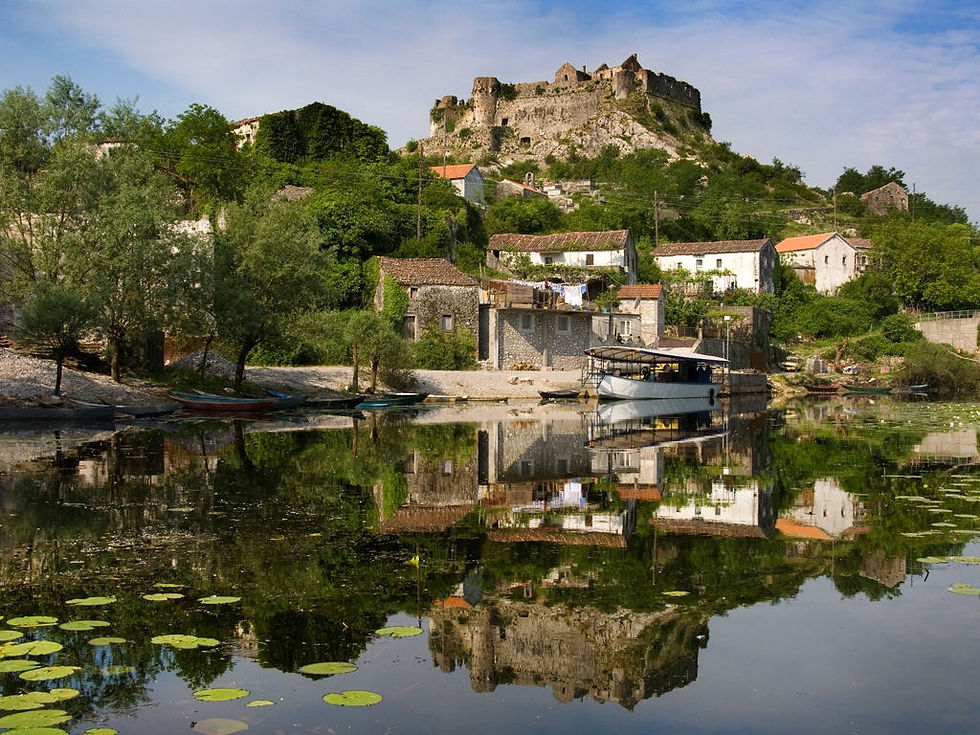
The remains of the Crnojevic Fortress are thought to date back to the 10th century, when the lords of Zeta built it for military purposes. With the accession of Duke Ivan Crnojevic in 1456, this fortress became the center of the ancient state's prosperity.
Nearby was a small town with 300 houses, and its proximity to the mouth of the Morača River facilitated the development of a market and medieval economic and commercial exchange, thus giving it great importance. Unfortunately, at the end of the 15th century, the fortress fell into the hands of the Turks, who dominated it for the next four centuries. The Turks converted the Crnojević court fortress into barracks, and the Church of St. George became a mosque. Over the centuries, it has undergone several renovations; remnants of Turkish rule remain, with less precise construction (a military site), while the older parts and towers were built of cut stone and limestone plaster, with some Venetian-style features.
Besac


The Besac fortress, located on a hilltop above the old fishing village of Virpazar, was built by the Turks in the second half of the 15th century, however it is assumed that some of the towers date back to an earlier period.
This fortress bordered Slavic and Turkish territories, and is therefore of particular historical significance for the entire Balkan Peninsula.
Like all the fortresses on the lake, it has changed use over time, and most recently, during the Second World War during the Italian occupation, it was used as a prison.
It is the only fortress restored today thanks to the support of the EU and the World Bank, it is truly a beautiful tourist attraction, and offers a magnificent view of the journey below and the lake.
Tophala

On the southwestern shore of Skadar Lake, opposite Ostros, lies a small island with the remains of a tower, similar in concept to some Greek structures. The tower was likely built in the 14th century, during the prosperous period when monasteries were established on the islands of Skadar Lake.
This tower protected the eastern passage from Shkodra to the islands where there were many inhabitants in the Middle Ages.
Of all the medieval fortifications preserved in Montenegro, the Tophala Tower has the simplest form and function. The tower is square in shape with four strong pilasters at the corners and another four on the walls between them. The entrance was at the top of the tower. It was built with larger pieces of broken stone pressed together in mortar. The walls are approximately 6 meters high and about 2 meters thick.
The lower part of the tower is well preserved today. In addition to the tower on the island, the remains of a three-story church were found in its foundations. This church is believed to date back to the 12th century and is likely a model for other three-story churches built on the islands of Lake Skadar in the 14th century.
The latter is among the least known, and I must admit that I only recently became aware of this historic island.
This shows that we Montenegrins ourselves are often unaware of the great historical and cultural wealth contained in our small country.


Comments