


CETINJE historical embassies

After 1878, when Montenegro's independence was recognized by the Congress of Berlin, European countries began establishing diplomatic relations with the new state, building impressive embassies in Cetinje. These buildings currently house libraries and other public institutions related to art and culture.
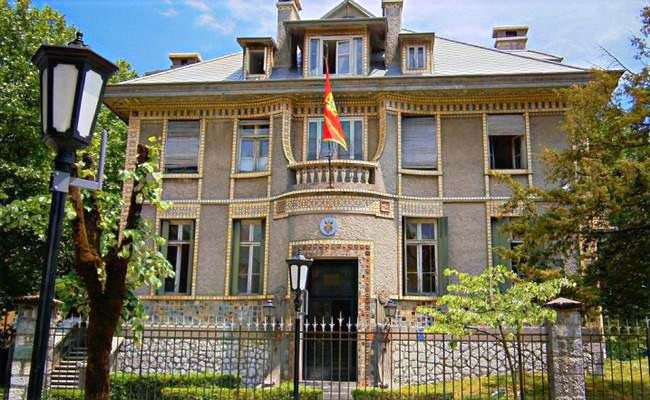
FRENCH EMBASSY
A particularly attractive building is
the French embassy in Art Nouveau style
(on the main street), decorated with ceramic tiles. It now houses the central library.
BRITISH EMBASSY

Unlike other European powers that placed their embassies in Cetinje in luxurious buildings, the building of the British Mission was designed as a small villa, discreet and well integrated into the surrounding area.
It was built near the old Lokanda Hotel, designed by the English architect Harty, in 1912.
Today the space is used for the needs of the Academy of Music.

SERBIAN EMBASSY
Exploring the city, you can easily
also track down the other embassies:
The Serbian embassy is located opposite the
Royal Palace (now the Ethnographic Museum), and next door is the Bulgarian Palace, now a charming café. Nearby is the Turkish Embassy, now the Academy of Dramatic Arts.
RUSSIAN EMBASSY

In accordance with the decision of the Russian Imperial Government, the construction of the Russian Embassy began in 1900.
Designed by the famous Italian architect Coradini, in the late Baroque style, it was completed in 1903. The sculptural decorations on the main façade and the shape and arrangement of the openings give this building a unique beauty. Today it houses the Faculty of Fine Arts.
AUSTRO-HUNGARIAN EMBASSY

This monumental building, built by architect Joseph Slade from 1897 to 1899.
Diplomatic customs, including religious ones, were transferred to a small Balkan town, and for this reason, a Roman Catholic chapel in neo-Romanesque style was built on the north side of the building. The chapel's façade ends in an attic with figures of the Virgin and two angels. The entire structure is complemented by a garden with tennis courts. The park is enclosed by a stone and wrought-iron fence. Over the course of its history, the building has changed its purpose several times. During the Austro-Hungarian occupation, it served as the headquarters, and between the two world wars, as the command post for the Zeta Division. Today, this building is part of the Academy of Fine Arts.
ITALIAN EMBASSY

Italy's diplomatic stronghold, which established diplomatic relations with Montenegro in 1879, was located in the current building of the Đurde Crnojević National Central Library. It was designed by the Italian architect Coradini, whose signature is evident in its simple exterior and sumptuous interior. The cornerstone was laid in 1905, with construction continuing four years later and completed in 1910. Like most diplomatic buildings, it was surrounded by a beautiful park, and even before the building was completed, the surrounding area was used for tennis and golf.


Comments